PEOPLE AND PLACES

All over the world in different countries, cultures, tongues, and colors are people who have the same basic desire for happiness and respect from his fellow men. We are the same all over as members of the human race. If we honor each other's boundaries with propriety and consideration our voyage thru life can be rich in knowledge and friendship..........AMOR PATRIAE
Wednesday, December 8, 2021

Friday, December 3, 2021
Where the housing market is going in 2022 as told by 7 leading forecast models
A perfect storm. That's the best way to describe the red-hot housing market we've seen from coast-to-coast during the pandemic. It was spurred by a combination of recession-induced low mortgage rates, remote work allowing buyers to sprawl further away from their workplace, and a demographic wave of first-time millennial homebuyers entering into the market. Of course, years of under-building means there simply aren't enough homes available to meet this demand. Cue record price growth.

But how much longer will this run last? After all, home price appreciation of 19.9%—a 12-month record set between Aug. 2020 and Aug. 2021—can't be sustained forever.
Already, there are signs the housing boom is losing some steam. We're seeing seasonality—a cooling period that happens like clockwork most years—return to the market after it was absent during the holiday and vacation stretch last year. That's not all: More homebuyers are finally beginning to push back against surging prices. Indeed, in October 60.3% of sales involved a bidding war, which is down from the all-time high in April (74.5%). There's also the increased likelihood the Federal Reserve will raise rates to tamp down inflation. Rising mortgage rates would price out some buyers altogether.
What does this mean for home price growth in 2022? To find out, Fortune reviewed seven industry forecast models. But buyers and sellers alike won't get much peace of mind from these forecasts: The economic models don't produce anything close to a consensus. Some of these forecast models predict price growth next year will go down as one of the highest on record. Others are forecasting a rate of appreciation that would be the slowest in more than a decade.
Let's take a look at these models—and also look at why there's so much uncertainty heading into next year.
On the high end of the spectrum are Zillow and Goldman Sachs. Zillow projects home prices will rise 13.6% between Oct. 2021 and Oct. 2022. Meanwhile, Goldman Sachs forecasts a 16% uptick between Oct. 2021 and Dec. 2022 (or 13.5% on an annualized basis). For perspective, the largest 12-month uptick in the lead up to the 2008 housing crash was 14.1%. Simply put: Researchers at both Zillow and Goldman Sachs see priced out buyers falling further behind next year.
“The supply-demand picture that has been the basis for our call for a multiyear boom in home prices remains intact...Of all the shortages afflicting the U.S. economy, the housing shortage might last the longest," wrote Goldman Sachs in its 2022 outlook.
What's going on? Well, neither Zillow nor Goldman Sachs foresees the demographic wave of first-time millennial homebuyers letting up. We’re in the midst of the five-year period (between 2019 and 2023) in which the five largest millennial birth years (between 1989 and 1993) are hitting the all-important first-time home buying age of 30. According to their forecasts, there won't be enough homes to satisfy all of that demand next year.
Since 1980, Fortune calculates home prices on average have climbed 4.6% per year. Over the past year, price growth (19.9%) is four times that level.
The good news for would-be home buyers? Among the seven forecast models Fortune examined, four predict we'll see price growth in 2022 fall back closer to the historical average. That includes Fannie Mae and Freddie Mac, which are predicting U.S. home price growth of 7.9% and 7%. That's slightly higher than the historical norm, however, it's hardly the eye-popping numbers we've seen during the pandemic. Meanwhile, models released by Redfin and CoreLogic foresee 12-month price growth falling to 3% and 1.9%, respectively.
What do the models predicting substantial price deceleration have in common? They foresee price growth getting chopped down by rising mortgage rates. As of Monday, the average 30-year fixed mortgage rate stands at just 3.1%. By the end of 2022, Fannie Mae projects it'll hit 3.4% while Redfin's model says 3.6%. Those jumps are bigger than they might appear at first glance. Let's say a borrower took on a $500,000 mortgage. At a 3.1% mortgage rate, they'd see a $2,135 monthly payment (not factoring in any taxes or insurance). But if that rate were the 3.6% as projected by Redfin, that payment would rise to $2,273—or nearly an additional $50,000 over the course of the 30-year mortgage.
Another unknown: Will corporate America begin pushing harder next year to bring staffers back into the office? If the workplace is less WFH friendly next year, that could translate into fewer buyers in both second home markets (like the Hamptons) and in the exurbs. That concern is shared by Frank Martell, CEO of CoreLogic, who wrote in the real estate data firm's latest forecast that "as we head into 2022, we expect some moderation in the current pattern of flight away from urban cores as the pandemic wanes.”
But there is one outlook that is relatively bearish on price growth.
The Mortgage Bankers Association, an industry trade group, is predicting that the median price of existing homes will decrease by 2.5% between the fourth quarter of 2021 and the fourth quarter of 2022. When you look closely at its model, it's easy to see why: The Mortgage Bankers Association is forecasting that the average 30-year fixed mortgage rate will hit 4% by the end of 2022. Over the course of 30 years, that'd add an additional $90,000 in cost to a $500,000 fixed rate mortgage
That said, even if the Mortgage Bankers Association's price drop comes to fruition, it'd hardly be a housing crash. In fact, in that scenario, U.S. home prices would still be up over 20% from pre-pandemic levels.
Thursday, December 2, 2021
GEOPOLITICS OF FRANCE: WILL MACRON MAKE EUROPE A SUPER POWER
The 21st century brings great changes for the world order. The French recognize these and want Europe to keep up with the US and China. Will France lead Europe towards a superpower? Welcome to the next episode of The 20s Report.
How President Macron plans to capture Africa's demographic wave by using the French language, with the ultimate goal to cement French hegemony worldwide. BAKU - For centuries, France was a global powerhouse, permeating its will over five continents. Since those imperial days, it has lost considerable ground in its former domains. Only in Africa did France retain its hold, owing to the monetary system that was put in place. In the decade after World War II, President François Mitterand was quoted saying: “Without Africa, France will have no history in the 21st century.” Like a foretelling coming true, it is precisely because of Africa that modern-day France is returning as the global force it once was. And it’s using the soft power attributes of language to cement its hegemony
Can Macron lead the European Union after Merkel retires?
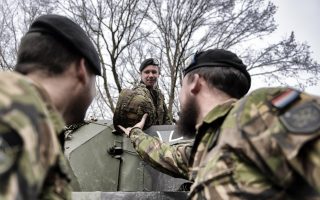
Troops from a European tank battalion that consists of Dutch and German soldiers prepare for an exercise near Oldenburg in northern Germany on Feb. 4, 2019.
After Germans vote Sunday and a new government is formed, Chancellor Angela Merkel will leave office after 16 years as the dominant figure in European politics. It is the moment that French President Emmanuel Macron has been waiting for.
The German chancellor, although credited for navigating multiple crises, was long criticized for lacking strategic vision. Macron, whose more swaggering style has sometimes ruffled his European partners — and Washington — has put forward ideas for a more independent and integrated Europe, better able to act in its own defense and its own interests.
But as the Anglo-American “betrayal” in the Australian submarine affair has underscored, Macron sometimes possesses ambitions beyond his reach. Despite the vacuum Merkel leaves, a Macron era is unlikely to be born.
Instead, analysts say, the European Union is heading for a period of prolonged uncertainty and potential weakness, if not necessarily drift. No one figure — not even Macron or a new German chancellor — will be as influential as Merkel was at her strongest: an authoritative, well-briefed leader who quietly managed compromise and built consensus among a long list of louder and more ideological colleagues.
That raises the prospect of paralysis or of Europe muddling through its challenges — on what to do about an increasingly indifferent America, on China and Russia, and on trade and technology — or even of a more dangerous fracturing of the bloc’s always tentative unity.
And it will mean that Macron, who is up for reelection in April and absorbed in that uncertain campaign, will need to wait for a German government that may not be in place until January or longer, and then work closely with a weaker German chancellor.
“We’ll have a weak German chancellor on top of a larger, less unified coalition,” said Mujtaba Rahman, managing director for Europe of the Eurasia Group, a political risk consultancy. “A weaker chancellor is less capable of exerting influence in Europe, and then with the Macron election, the political cycles of these two key countries will not be in sync.”
The uncertainty is likely to last until after the French parliamentary elections in June — and that is presuming Macron wins.
Macron has argued forcefully that Europe must do more to protect its own interests in a world where China is rising and the United States is focusing on Asia. His officials are already trying to prepare the ground on some key issues, looking forward to January, when France takes over the rotating EU presidency. But given the likelihood of lengthy coalition talks in Germany, the window for accomplishment is narrow.
Macron will need German help. While France and Germany together can no longer run the European Union by themselves, when they agree, they tend to bring the rest of the bloc along with them.
So building a relationship with the new German chancellor, even a weaker one, will be a primary goal for Macron. He must be careful, noted Daniela Schwarzer, executive director for Europe and Eurasia of the Open Societies Foundations, not to scare off the Germans.
“Macron’s leadership is disruptive, and the German style is to change institutions incrementally,” she said. “Both sides will need to think through how they make it possible for the other side to answer constructively.”
French officials understand that substantive change will be slow, and they will want to build on initiatives already underway, like the analysis of Europe’s interests called “the strategic compass” and a modest but steady increase in military spending on new capabilities through the new European Defense Fund and a program called Pesco, intended to promote joint projects and European interoperability.
After the humiliation of the scuttled submarine deal, when Australia suddenly canceled a contract with France and chose a deal with Britain and the United States instead, many of his European colleagues are more likely now to agree with Macron that Europe must be less dependent on Washington and spend at least a little more in its own defense.
Few in Europe, though, want to permanently damage ties with the Americans and NATO.
“Italy wants a stronger Europe, OK, but in NATO — we’re not on the French page on that,” said Marta Dassu, a former Italian deputy foreign minister and director of European affairs at the Aspen Institute.
Italian Prime Minister Mario Draghi, whose voice is respected in Brussels, believes strongly in the trans-Atlantic relationship, Dassu said, adding, “We’re closer to Germany than to France, but without all the ambiguities on Russia and China.”
France also wants to become more assertive using the economic and financial tools Europe already has, especially trade and technology, the officials say. The point, they say, is not to push too hard too fast, but to raise the European game vis-à-vis China and the United States, and try to encourage a culture that is comfortable with power.
But France’s German partners will be going through a period of uncertainty and transition. A new German chancellor is expected to win only one-quarter of the vote and may need to negotiate a coalition agreement among three political parties. That is expected to take at least until Christmas, if not longer.
The new chancellor will also need to get up to speed on European issues, which barely surfaced in the campaign, and build credibility as the newcomer among 26 other leaders.
“So it’s important now to start thinking of concrete French-German wins during a French presidency that Macron can use in a positive way in his campaign,” Schwarzer said. “Because Berlin does not want to ponder a scenario in which Macron loses” to far-right Marine Le Pen or in which euroskeptics like Matteo Salvini take over in Italy.
Whoever wins, German policy toward Europe will remain roughly the same from a country deeply committed to EU ideals, cautious and wanting to preserve stability and unity. The real question is whether any European leader can be the cohesive force Merkel was — and if not, what it will mean for the continent’s future.
“Merkel herself was important in keeping the EU together,” said Ulrich Speck of the German Marshall Fund. “She kept in mind the interests of so many in Europe, especially Central Europe but also Italy, so that everyone could be kept on board.”
Merkel saw the European Union as the core of her policy, said a senior European official, who called her the guardian of true EU values, willing to bend to keep the bloc together, as evidenced by her support for collective debt, previously a German red line, to fund the coronavirus recovery fund.
“Merkel acted as mediator when there have been a lot of centrifugal forces weakening Europe,” said Thomas Kleine-Brockhoff, head of the Berlin office of the German Marshall Fund. “It’s less clear how the next chancellor will position himself or herself and Germany.”
Still, Mark Leonard, director of the European Council on Foreign Relations, noted that “whoever is the chancellor, Germany is still responsible for more than half of Chinese trade with Europe.” Germany is “vastly more important than the other countries on all the big issues, from how to handle China to the tech wars and climate change,” he said.
That means Macron “knows he has to channel German power behind his vision,” he said.
But French and Italian positions will be crucial, too, on important pending financial issues like fiscal and banking integration, trying to complete the single market and monitoring the pandemic recovery fund.
Merkel’s departure may provide an opportunity for the kinds of change Macron desires, even if in vastly scaled-down version. Merkel’s love of the status quo, some analysts argue, was anachronistic at a time when Europe faces so many challenges.
Perhaps most important is the looming debate about whether to alter Europe’s spending rules, which in practical terms means getting agreement from countries to spend more on everything, from defense to climate.
The real problem is that fundamental change would require a treaty change, said Guntram Wolff, director of Bruegel, a Brussels research institution. “You can’t have fiscal and defense integration by stealth,” he said. “It won’t have legitimacy and won’t be accepted by citizens.”
But the German election debates ignored these broad issues, he said.
“The sad news,” Wolff said, “is that none of the three chancellor candidates campaigned on any of this, so my baseline expectation is continued muddling forward.”
Who will lead Europe after Merkel? Presidents and prime ministers jockey for the job.
As Germany prepares to elect its next chancellor Sunday, Europe is readying itself for a major shake-up of the unofficial hierarchy of continental leaders.
In nearly 16 years at the helm of Europe’s largest economy, Angela Merkel became the de facto representative on the world stage and the European Union’s chief power broker through countless late-night negotiations and a string of crises.
Germany will continue to wield immense influence. However, Merkel’s experience and reputation give her clout that none of her potential successors as chancellor could hope to match anytime soon. And so her departure will create an opening — for the first time in more than a decade — for other leaders to assert themselves and their vision for Europe.
A few favorites have emerged in the competition. French President Emmanuel Macron, head of the European Union’s second-biggest economy, has been jockeying for years to be the next leader of Europe. Italian Prime Minister Mario Draghi, best known for saving the euro while president of the European Central Bank, also has several of the necessary credentials.
But analysts, politicians and diplomats tend to agree that no one person is capable of filling Merkel’s loafers. Instead, they say, it will probably involve a coterie of premiers — probably all of them men.
“Merkel’s exit creates a problem with leadership, a hole at the heart of Europe,” said Giovanni Orsina, director of Luiss Guido Carli University’s School of Government in Rome. “Either the new chancellor fills that void, or we need to conceive of a collective convergence.”
After 16 years, Germany’s Merkel is stepping down. Here’s how she built her legacy.
There will be a marked shift in the balance of power, said a senior E.U. diplomat, and other European leaders will have to step up.
“This cannot only be done by one. It has to be done by the group,” he said, speaking on the condition of anonymity to discuss the sensitive political situation.
Merkel isn’t expected to leave office immediately after the election. The results are likely to be messy, and coalition talks could go through the end of the year — or beyond. Merkel would stay on as a caretaker until a new government is formed.
And then? Whoever steps into the job — the candidates include Armin Laschet, Olaf Scholz and Annalena Baerbock — would need time to settle in, and to establish themselves, before they could expect to command the sort of attention that Merkel has in Europe and internationally.
“Any German chancellor will move into a powerful position,” said Daniela Schwarzer, executive director for Europe and Eurasia at the Open Society Foundations. “Any next German chancellor will bring some experience and bring the same weight of the country to the table, but the personal weight will not be the same.”
What you need to know about Germany’s election
If Britain were still in the European Union, some of the power might shift across the English Channel. But in a post-Brexit world, London cannot expect to speak on behalf of the continent.
So, many heads are turning toward Paris.
“The German elections are being seen in France as an opportunity for a reset, where whoever comes in will have less stature than Macron does and whereby France’s influence in Europe would be increased,” said Nicholas Dungan, a senior fellow at the Atlantic Council.
Macron has been preparing for this moment. He has repeatedly sought to emphasize his foreign policy experience, drawing a contrast with the German chancellor candidates, who spent most of their televised debates bickering about domestic politics.
Macron also has spent years outlining his vision for Europe.
In 2017, after another German election, he delivered a sweeping speech at Sorbonne University, arguing that the best response to ascendant nationalists was to acknowledge the European Union’s shortcomings — it is “too weak, too slow, too inefficient” — and then to work to make it stronger and more united.
He has reprised the theme many times. But his proposals — to integrate European defense, reform the euro zone, develop a common asylum policy and impose a new tax on U.S. tech giants — have not been enthusiastically embraced.
French ambassador to return to Washington as Biden, Macron seek to mend rift
The French president has lately been using the chaotic Afghanistan withdrawal, and a fight with the Biden administration over a nuclear submarine deal, to reiterate a call for European “strategic independence.” Other E.U. leaders have said they stand with France in the submarine spat, and they are equally frustrated about Afghanistan. Still, the idea of an E.U. military is far from becoming a reality.
Macron’s mandate as Europe-wide leader may depend in part on how much progress he makes when France takes over the Council of the European Union’s rotating six-month presidency in January — as well as on his showing in France’s presidential election in April. His main competitor, far-right leader Marine Le Pen, has a radically different view of the European project.
“To the question who will take the mantle, you already know the answer: It will be Macron,” an E.U. diplomat said, speaking on the condition of anonymity to offer a candid assessment. “The next question is: Will he retain the mantle?”
The determining factor, the diplomat said, may be whether Macron can learn to compromise.
“Macron has the tools and the chance to, for now, fill that void,” the diplomat said. “But he will only stay there in that position if he manages to bridge the gap between him and his way of doing things, and the east and the north and everybody else. That was Merkel’s way.”
Does the European Union need its own army? Afghanistan withdrawal revives an old debate.
Merkel’s critics, however, sometimes hold that against her. They say she delayed decisions at the E.U. level in an effort to preserve consensus and avoid conflict — and while doing so allowed for the erosion of democratic norms in countries such as Hungary and Poland. Her approach even earned its own verb: “Merkeln,” meaning to dither or bide one’s time.
“During the Merkel era, one always tried to handle and solve things among the 27, often postponing until the very last minute the required solutions for Europe, because of Merkel’s conviction that results could only be yielded by standing together,” said Sandro Gozi, a veteran Italian politician who now represents France in the European Parliament as part of Macron’s centrist “Renaissance” list.
“I believe Macron and Draghi can make all the difference here,” Gozi said.
The French president and Italian prime minister were dubbed Europe’s “new power couple” by Politico in July, amid reports of a transalpine bromance. The two men, separated in age by 30 years, are both former investment bankers and longtime E.U. boosters, and have similar goals for the 27-nation bloc, especially on fiscal policies, where both favor further financial integration.
“I believe that in this new phase, leadership could be collective,” Gozi said. “I see Macron and Draghi as protagonists of that.”
At first, their leadership of Europe would be “two-legged,” Gozi said, but it would eventually include the new German chancellor. Indeed, many observers expect Macron would need strong German partnership to execute the most ambitious of his plans. But Gozi said the result would be “less Merkel-ian” — with faster action and less caution.
Germany’s Merkel makes final campaign push for stumbling political heir
Draghi has been positioning himself to take on a greater leadership role, observers say. He was a prominent voice in Europe’s reaction to the Afghanistan withdrawal, pushing for an emergency summit of the G-20, criticizing the European Union’s disorganized stance on accepting refugees, and calling President Biden during the evacuation efforts. In March, Draghi made headlines when he blocked the export of a batch of AstraZeneca coronavirus vaccine doses from the European Union amid a shortage inside the bloc. And he has been talking of using nearly $235 billion in E.U. money to enact an “epochal” pandemic recovery.
But his own sway may be limited by the size and influence of his country.
“The problem across history is not only who you are but the kind of car you’re driving,” said Orsina, of Luiss Guido Carli University. “Some things you can only do if you’re Germany, otherwise it’s that much harder, regardless of the leader’s personality.”
A number of other leaders will be elbowing for a more important role, including Spanish Prime Minister Pedro Sánchez and Dutch Prime Minister Mark Rutte. Both share one obvious trait with their counterparts in France and Italy: They’re men.
After Merkel’s departure, council summits risk taking on the feel of an old boys’ club, said Open Society’s Schwarzer.
“There’s a certain element of having a female leader at the table — the balance will shift in that regard, as well, and that does make a difference in group dynamics,” she said. “Not only what happens in the room but the reception of politics.”
Some Europeans are sure to welcome Merkel’s egress as a chance for potential realignment and more substantive reforms to the European Union.
The Merkel era “has led to a Europe that is highly dependent on Germany and Germany’s choices,” said Rosa Balfour, the director of Carnegie Europe. “The gravity of power has shifted to Berlin, and it hasn’t been all for the good of the rest of Europe. If there’s a slight change in the balance of power, tipped in the favor of a broader pioneering group, from a European perspective there could be benefit in that.”
Critics argue, for instance, that Germany’s response to the euro-zone debt crisis and its push for austerity measures did deep and lasting damage to Greece and Italy, Balfour said.
Still, Merkel’s support remains strong across the continent — yet another indicator of how difficult she will be to replace. A recent survey by the European Council on Foreign Relations asked residents in 12 E.U. nations who they would vote for in a hypothetical election for president of Europe, Merkel or Macron.
Tuesday, November 30, 2021
GEOPOLITICS OF ROMANIA
US army tanks and soldiers continued being deployed on Tuesday to an air base in southern Romania, after the first shipment of tanks had arrived the day before. The tanks were offloaded from a train in the village of Mihail Kogalniceanu, where they would be taken to a nearby military air base. The deployment, known as Operation Atlantic Resolve, is part of an American operation to reassure NATO allies and other partners concerned about Russia. Five hundred US soldiers will eventually be deployed at the Mihail Kogalniceanu Air Base in Constanta County. The operation foresees the continuous presence of an American armoured brigade combat team in Europe on a nine-month rotational basis.
US to Turn Romanian Airbase into NATO Black Sea Hub

A US Air Force F16 jet takes off during the joint Romanian-US military drill ‘Dacian Viper 2014’ at the Campia Turzii military airbase, April 2014. Archive photo: EPA/MIRCEA ROSCA
The US Air Force will this month start awarding contracts for construction work to upgrade the Campia Turzii base, enabling it to support heavy cargo aircraft and host fighter jets, boosting NATO’s capacities in the Black Sea area.
“We are getting ready to award four projects for construction between May and August 2021,” Darren Walls, a design and construction program manager at the European Deterrence Initiative launched by the US after Russia’s annexation of Crimea in 2014, said in a US Air Force statement quoted on Tuesday by Romanian media.
“The upgrade is important because Romania needs to boost its capacity to receive further NATO aircraft in case of a crisis or conflict that require a collective response,” former Romanian official and security expert Claudiu Degeratu told BIRN.
“Romania also needs a second major air base that meets NATO standards so it can serve its newly acquired F-16 jets,” Degeratu added.
He said that Russia’s buildup of troops around the Ukrainian border in April “shows that a quick renovation of the Campia Turzii base is needed”.
Romania and its US allies already have a large NATO airbase at Mihail Kogalniceanu near the Black Sea. The improvements at Campia Turzii will increase the US and NATO’s capabilities to respond to any potential threats and deter Russia in the region.
US Navy Captain Scott Raymont, the US European Command’s Logistic Directorate chief engineer, explained recently that the reconstruction works at Campia Turzii “include the construction of airfield infrastructure and supporting facilities necessary”.
This will enable the base “to sustain the [US] Air Force’s combat operation and surveillance missions while increasing logistics capabilities in the theatre”, he added.
Following Russia’s annexation of Crimea, the Black Sea has become a strategic priority for the US and NATO defence in Europe, as the Kremlin has heavily increased its activity and presence near the Western military alliance’s south-eastern flank.
As a result, the US and Romania have intensified their military cooperation. Former US President Donald Trump’s administration planned to redeploy some of the US troops he ordered out of Germany last year to Romania and Poland – a move welcomed by Romanian and Polish officials.
On May 10 this year, leaders of Central and Eastern European NATO member states met in Bucharest to discuss the recent mass deployment of Russian troops near the Ukrainian border.
“I advocated a bigger presence of the alliance and the US in the south of the [NATO] eastern flank,” Romanian President Klaus Iohannis said he told his US counterpart Joe Biden, who took part in the summit remotely.
Security analyst Degeratu said this was “a message to Biden so he continues Trump’s policy to redeploy troops in the region”.
Romania Unveils Patriot Missile System on Black Sea
Romania has become the first country to have a Patriot surface-to-air missile system in the Black Sea region, an area where Russia is increasingly perceived as a growing threat by Romania, the US and their NATO allies.

The Patriot surface-to-air missile system unveiled today in the Cape Midia, Romania. Photo: BIRN
Romania on Thursday received the first Patriot surface-to-air missile system acquired from US defense giants Raytheon and Lockheed-Martin, which has been hailed as a crucial step towards strengthening the country’s air defences in the Black Sea region, where Russia is increasingly active.
“The set-up of the first Patriot system is only a first step towards building a formidable air defence capability for our country, which will significantly contribute to consolidating deterrence and the defence of NATO on its eastern flank,” Romania’s Defence Minister, Nicolae Ciuca, said at the unveiling ceremony at the Cape Midia military base near the Black Sea port of Constanta.
Following the arrival of the first Patriot missile system, the Romanian military will receive another three missile systems in future. The remaining three missile systems will be delivered from 2022, military sources told BIRN.
Speaking at Cape Midia, the US ambassador to Bucharest, Adrian Zuckerman, saluted the acquisition of the Patriot system as a stride towards Romania becoming capable of defending itself and its NATO allies from threats. He singled out Russia and China among these threats.
The Patriot surface-to-air missile system unveiled today in the Cape Midia, Romania. Photo: BIRN
Romania on Thursday received the first Patriot surface-to-air missile system acquired from US defense giants Raytheon and Lockheed-Martin, which has been hailed as a crucial step towards strengthening the country’s air defences in the Black Sea region, where Russia is increasingly active.
“The set-up of the first Patriot system is only a first step towards building a formidable air defence capability for our country, which will significantly contribute to consolidating deterrence and the defence of NATO on its eastern flank,” Romania’s Defence Minister, Nicolae Ciuca, said at the unveiling ceremony at the Cape Midia military base near the Black Sea port of Constanta.
Following the arrival of the first Patriot missile system, the Romanian military will receive another three missile systems in future. The remaining three missile systems will be delivered from 2022, military sources told BIRN.
Speaking at Cape Midia, the US ambassador to Bucharest, Adrian Zuckerman, saluted the acquisition of the Patriot system as a stride towards Romania becoming capable of defending itself and its NATO allies from threats. He singled out Russia and China among these threats.
Globally, Romania is the 17th country to buy this US-built defence technology – Patriot being the acronym of Phased Array Tracking Radar to Intercept on Target – and which is capable of intercepting aircraft and both cruise and ballistic missiles.
“The acquisition of these systems solves a big problem for Romania’s national defence system,” military expert Claudiu Degeratu told BIRN. “We inherited only missile systems produced in the former USSR; Romania did not acquire anything of relevance in this field after [the advent of democracy in] 1990,” he added.
Degeratu explained that the purchase of the Patriot systems should be seen in the light of Russia’s “accelerated militarization of the peninsula of Crimea following its annexation of this region”, from Ukraine in 2014.
“The Russian Federation has deployed new fighter aircraft, new modern missile systems, and warships equipped with short, medium and long-range missiles, including supersonic and submarine missiles,” the same expert said.
In recent years, Romania has stepped up its defence capabilities in order to deter Russian advances in the region following the seizure of Crimea.
Since then, Russia has significantly increased its military might in the Black Sea, which Romania and its allies in NATO perceive as a threat.
These and other geopolitical developments have turned Romania into a cornerstone of US and NATO defence strategy in Europe.
Following the withdrawal of nearly 12,000 US troops from Germany, US officials have announced an intention to redeploy some them to Poland and Romania, to reinforce deterrence of Russia on NATO’s eastern flank.
The US already has two military bases in Romania and is planning to invest in turning the former Soviet airbase of Campia Turzii in Transylvania into a major hub from which to boost reconnaissance patrols over the Black Sea.
Monday, November 29, 2021
p> The Philippines is a frontline of another cold war
The Philippines is a frontline of another cold war

Like in the Cold War, the United States is attempting to contain the influence of a great power rival in Southeast Asia. To counter China, the United States' approach to its relationship with the Philippines invokes déjà vu. Despite the passing of decades, the players, strategy and results remain the same.
First, the players. Many who have studied U.S.-Philippines relations during the Cold War focus on the relationship between President Reagan and the infamous Philippine dictator Ferdinand Marcos. This is because Ronald Reagan was the quintessential "cold warrior" whose administration attempted to counter communist influence by supporting U.S.-aligned dictators the world over.
What gets less attention is President Carter's own complicity in propping up the Marcos regime. Carter, often categorized as a human rights-focused president, supported the Marcos regime after the declaration of martial law in the Philippines in an effort to keep U.S. access to military bases on the archipelago. While it is debatable whether Joe Biden is the new Jimmy Carter, he is a Democratic president who is claiming that his administration prioritizes human rights while navigating relationships with regimes that have dubious human rights records.
On the Philippines side, the comparison of President Rodrigo Duterte to Ferdinand Marcos is obvious: Duterte's drug war, encouragement of extrajudicial killings, shuttering of critical media and scoffing at international law echo the Marcos regime's myriad abuses. What's more, the children of both Marcos and Duterte are running on both parents' legacies in the Philippines presidential election.
Second, the strategy. The Philippines is, once again, seen as a geopolitically necessary bulwark against a superpower that threatens U.S. hegemony in the region. And again, the U.S. approach to containment is a prioritization of military superiority against China through access to bases on the Philippines.
To maintain access to these bases, the U.S. buys off the Philippine government with a steady stream of security assistance, turns a blind eye when atrocities are committed with said security assistance and reassures the Philippine government of lasting support whenever international or domestic criticisms are made.
Like in the first Cold War, the Philippine government is being given materials to engage domestic enemies, not foreign aggressors. Even with the most recently proposed arms sale of 10 F-16 fighter jets and a Harpoon Block II anti-ship missile system, the Philippines is no match for full-scale combat with the Chinese military and must rely on the military might of the U.S. to protect it. This approach does not foster sovereignty and self-determination; it leads to dependency and lackeyism.
Lastly, the results. In both cold wars, ordinary citizens at the crossroads of conflict were sacrificed. During the regime of Ferdinand Marcos, it is estimated that 3,257 people were murdered and 35,000 were tortured by the U.S.-backed Philippine security state. As of now, estimates put Duterte and his security forces' body count at approximately 30,000; this does not figure in the recent spate of killing human rights defenders. Along with Duterte's killings, his crackdown on critical media and political opposition mirrors Marcos's approach to dissent. As with most reigns of terror, we will not know the gravity or magnitude of the abuses committed until the regime has long disappeared.
What happened after Marcos's ouster was a critical reevaluation by the Filipino people of the Philippines' relationship with the United States due to the United States' unwavering support of Marcos.
As a result, the reawakened democracy voted in 1991 not to ratify a treaty that allowed the U.S. access to bases in the Philippines. It wasn't until 2014, with the signing of the Enhanced Defense Cooperation Agreement, that the U.S. was allowed to fully station bases in the Philippines. If the U.S. is determined to follow the exact same approach in the new cold war with regards to the Philippines, a similar backlash is bound to occur.
Setting aside the questionable utility of participating in another cold war, the United States owes it to the people of the Philippines not to repeat the mistakes we made in the first Cold War. This starts with distancing ourselves from human rights abusers who will cause more harm than good in the long term, and taking steps to demonstrate that human rights are a priority.
One substantial way to do this is to limit U.S. military aid to the armed forces of the Philippines and Philippine National Police. By withholding security assistance until perpetrators of human rights violations are held accountable for their actions, the U.S. creates an incentive for the government of the Philippines to develop a framework to address human rights concerns and gives the U.S. moral consistency when criticizing other states of human rights abuses.
Monday, November 22, 2021
Did George H.W. Bush Coordinate a JFK Hit Team?
This is not the first time and surely will not be the last that George H.W. Bush, former Director of the CIA and the 41st President of the United States, has been implicated in the death of John Fitzgerald Kennedy, our 35th president. In an earlier study, for example, “Was George H.W. Bush involved in the assassination of JFK?”, John Hankey and I both address this question, where he provides a great deal of evidence supporting a role for GHWB in the Dealey Plaza turkey shoot. In this new study, Richard Hooke substantiates that claim and advances additional proof of his own. I believe that they are right. That GHWB knew Malcolm “Mac” Wallace from Yale is especially stunning. ”Mac” Wallace was LBJ’s personal hit man and murdered as many as a dozen persons for Lyndon, including one of his own sisters, who was talking too much about his business to allow her to continue to speak. There is substantial proof that LBJ was involved in the assassination, where his life had been dedicated to becoming “the president of all the people”. As Phil Nelson, LBJ: Mastermind of JFK’s Assassination (2nd revised edition, 2011) documents, he was relentless in its pursuit. Madeleine Duncan Brown, Texas in the Morning (1997), Barr McClellan, Blood, Money & Power (2003), and Billy Sol Estes, A Texas Legend (2004), have also identified LBJ as the pivotal player, which has been confirmed by E. Howard Hunt, “Last Confessions” (2007), who identified LBJ, Cord Meyer, David Atlee Phillips, William Harvey and David Sanchez Morales as in “the chain of command”. Even Jack Ruby, who was in the position to know, asserted that, if someone else had been Vice President, the assassination would never have occurred. McClellan concluded that Texas oil men, such as Clint Murchison and H. L. Hunt, had provided financing for the assassination in order to preserve the oil depletion allowance at 27.5%, which remained unchanged under LBJ. I had over 100 conversations with Madeleine Duncan Brown, who began an affair with Lyndon in 1948 and bore him a son, Steven, in 1950 (who was not his only child out of wedlock but was his only male offspring), who told me about their renderzvous at the Driskill Hotel in Austin, TX, on New Year’s Eve, only six weeks after the assassination, when she confronted him with rumors that he had been involved, since no one stood to gain more personally, whereupon Lyndon blew up and told her that the CIA and the oil boys had decided that JFK had to be taken out. And that Mac Wallace was involved is not in serious doubt.
This is consistent with Billy Sol’s interview with French investigative reporter, William Reymond, during which he explained that Lyndon had sent his chief administrative assistant, Cliff Carter, down to Dallas to make sure that all the arrangements for the assassination were in place, which he reaffirms in A Texas Legend (2004). Billy Sol knew both Cliff Carter and “Mac” Wallace personally, inferring their involvement from personal conversations. A copy of email correspondence between John Simkin of The Education Forum and Douglas Caddy may be found on amazon.com, which substantiates Lyndon’s use of Cliff Carter to convey instructions to “Mac” Wallace to commit those crimes. I am therefore stunned to discover that GHWB and “Mac” Wallace were both members of Skull & Bones at Yale. Why the Dal-Tex MattersAccording to The Warren Repor (1964), three shots were fired during the assassination. The FBI and the Secret Service concluded that day that the first had hit JFK in the back, the second had hit John Connally in the back, and the third had hit JFK in the back of the head, killing him. It would later surface that one shot that had been fired had missed and injured a distant bystander, James Tague. For those who believed more than three shots had been fired, this was not especially problematic, where it turns out that eight, nine or ten shots appear to have been fired from six different locations. (See, for example, “Dealey Plaza Revisited: What happened to JFK?”) But for those who are committed to only three, it posed a delicate predicament, which led to the fabrication of the “magic bullet” theory that the back shot had actually hit the back of his neck, exited his throat, and entered the back of Connally.
All of the evidence is against it; indeed, it is not only provably false but not even anatomically possible, insofar as cervical vertebrae intervene, as I explain in “Reasoning about Assassinations”. It nevertheless became the fulcrum of the “official account”, since otherwise the throat wound and the wounds to Connally have to be explained on the basis of other shots and other shooters. Extensive, meticulous and detailed examination of the medical, ballistic and eyewitness testimony supports the conclusion that JFK was hit four times–once in the back (from behind); once in the throat (from in front); and twice in the head (once in the back of the head from behind and once in the right temple from the right/front). None of those shots appear to have been fired from the 6th floor “assassin’s lair” but three from the Dal-Tex, where the acoustics were such that they sounded as though they could have been fired from the Texas School Book Depository. Richard’s study suggests that GHWB was at that window of the Dal-Tex:
George H.W. Bush Coordinated the Dal-Tex Hit TeamGHWB at the TSBD: a Houston oil man by Richard HookeGeorge H.W. Bush was working for the CIA at least as early as 1961; more than likely he was recruited in his college days, at Yale, when he was in the Skull and Bones Society. He and his wife Barbara moved to Houston where he ran an offshore oil drilling business, Zapata Offshore Co., which was a CIA front company with rigs located all over the world, making it very convenient for him to vanish for weeks at a time on CIA business where one would suspect what he was doing. Bush was a major organizer and recruiter for the Bay of Pigs invasion, which was codenamed Operation ZAPATA. Col. Fletcher Prouty, former Pentagon high ranking official, who was the basis for the “Col. X” character in Oliver Stone’s “JFK”, obtained two Navy ships for the operation that were repainted to non-Navy colors and then renamed HOUSTON and BARBARA. George H.W. “Poppy” Bush is one of the few who could never recall where he was or what he was doing when JFK was assassinated; as a matter of fact, for over 20 years, he could not recall any details at all. He was 39 years old at the time and chairman of the Harris County (Houston) Republican Party and an outspoken critic of JFK. But on 21 November 1963, GHWB was staying at the Sheraton Hotel in downtown Dallas and spoke that very evening to the American Association of Oil Drilling Contractors. Some time later,he was reportedly at “the ratification meeting” at the home of Clint Murchison, Sr., receiving last minute instructions and toasting JFK’s murder the night before it happened. [NOTE: Madeleine Duncan Brown has written about this event in her book, Texas in the Morning (1997). It was corroborated by Nigel Turner in Part 9, "The Guilty Men", of "The Men who Killed Kennedy".] Deputy Sheriff Roger Craig reported to Jim Garrison he knew of twelve arrests made in Dealey Plaza that day. One, in particular, was made by R.E. Vaughn of the Dallas Police Department, was of a man coming out of the Dal-Tex Building, who said he was “an independent oil operator from Houston, Texas.” The prisoner was taken from Vaughn by Dallas Police detectives, and that was the last he saw of him: no mug shot, no interview, no fingerprints, or name is in existence of this mystery man. “Independent oil operator from Houston” was always George Bush’s (CIA) cover. Exactly why was he arrested? Garrison reported the man came running out of the Dal-Tex building and authorities could hardly avoid arresting him because of the clamor of onlookers. He was taken to the Sheriff’s Office for questioning, although there is no record of it. Afterward, two officers escorted him out of the building to the jeers of the waiting crowd. They put him in a police car and he was driven away; presumably right back to Dealey Plaza, because that is where he would be photographed with USAF Gen. Edward Lansdale. Ed Landsdale was identified walking past “the three tramps” (center) by no less authorities than L. Fletcher Prouty, the liaison between the Pentagon and the CIA for covert activities–who was the basis for the figure, “Col. X”, in Oliver Stone’s “JFK”, and Victor Krulak, former Commandant of the Marine Corps, both of whom knew him well. As for the identity of GHWB, we have these observations from Ralph Cinque, a professional chiropractor, who is an expert in dealing with person’s bodies and clothing, “The case for George HW being there is cinched. What’s the serious alternative? That a simply amazing coincidence occurred in which a man who looked strikingly like him just happened to be there? How many times does V (for Vendetta in the film, “V for Vendetta”) have to tell us that he, like God, does not play dice and does not believe in coincidences? Neither do I or any other serious student of murder, especially not when it involves the JFK assassination.” We have a photo of him standing in front of the Texas School Book Depository; we have photos of Ed Lansdale in Dealey Plaza at the time; and we have yet another in which Lansdale, who was famous for arranging assassinations around the world, is waiting to speak to him. In this case, it may justifiably be said that “these pictures really are worth more than a thousand words”. The Phony AlibiThe next that we hear of George H.W. Bush on 22 November 1963 comes from an FBI Memorandum according to which GHWG, having been cut loose from his anonymous interrogation at the Dallas Sheriff’s Office, called into SAC Graham W. Kitchel of the FBI Office in Houston alleging was establishing a phony alibi in saying he recalled hearing, in recent weeks, a man named James Parrott talking of killing the President when he came to Houston. Shortly after Bush made this call, FBI agents were dispatched to the Parrot house. In another FBI memo Parrot’s mother said James, who was not home when the FBI arrived, had been home all day helping her care for her son Gary. Mrs. Parrot advised that shortly after 1 PM a Mr. Reynolds came by and talked to her son about painting some signs at Republican Headquarters on Waugh Drive. The net effect was Kerney Reynold’s, George Bush’s assistant, gave Parrot an alibi and Parrot was Bush’s alibi; everyone’s ass was covered. A bogus phone call reporting a would-be assassin who was one of Bush’s Republican Party sign-painters; who himself is also freed by an alibi from one of Bush’s buddies, really doesn’t cut it; this is CIA Alibi 101. This type of stuff cannot be allowed to stand in history; if Bush was so concerned about his sign painter, why didn’t he call in to alert the FBI before President Kennedy came to Dallas? Bush has handed us his head on a silver platter with this memo; that’s why he always said he didn’t remember what his was doing on 11/22/63; he was hoping this incredibly stupid memo never surfaced. Bush was worried he had been seen and subsequently panicked and stupidly called the FBI, thinking he was being clever by providing evidence that it wasn’t him that was arrested in front of the Dal-Tex building that day. It seemed like a good idea, at the time, but he was actually creating a permanent record of his involvement. The memo identifies Bush as an oil man from Houston placing a long distance call from Tyler, Texas. Bush was trying to establish he was not in Dallas during, or shortly after, the assassination. He must had been worried that someone would identify him as the oil man detained running out of the Dal-Tex building and being ushered in and out of the Dallas Sheriff’s office.
Conspicuously, this FBI memo fails to provide an answer to where George Bush actually was. The memo, however, does tell us that the first moment Bush was free to create a phony alibi was at 1:45 PM. Bush was staying in downtown Dallas at the Sheraton Hotel, just few blocks from Dealey Plaza, yet he’s trying to tell us he was in Tyler, Texas at 1:45 PM. George Bush’s CIA assignment was obviously in Dallas, that’s why he was staying there, so what would he have been doing in Tyler? JFK had just been shot at 12:30 PM. Would Bush not have been in Dallas at 12:30 PM as well, like everyone else, which was presumably the reason for him having been in town at the Dallas Sheraton Hotel? Would Bush not have driven down the road to Parkland Hospital, to check on the President’s condition; like everyone else? Except Bush was being interrogated at the Sheriff’s Office. The FBI MemorandumBush appears to be a candidate for prosecution for treason: his alibis for 22 November 1963 are fabricated and we have evidence that shows he was there. An FBI memo of a call from Tyler Texas does not prove his location, except that he had concocted a textbook CIA alibi, that he was lying and probably was an accessory to JFK’s murder. Bush maintained for over twenty years after the assassination that he simply did not remember what he was doing at the time of the assassination. As a matter of fact, he had no explanation even in his autobiography; and then, all of a sudden, he concocted a story that he was speaking in Tyler, Texas to The Rotary Club. Aubrey Irby said Bush was speaking when the bellhop came over and informed Aubrey that JFK was dead. Mr. Aubrey passed the info on to Mr. Wendell Cherry Irby, who passed it onto Bush, who stopped his speech. According to Irby, Bush explained he thought a political speech was inappropriate under the circumstances, concluded speaking and simply sat down. It is inconceivable that George Bush could not have recollected this event for more than 20 years. Walter Cronkite’s announcement to the world that JFK was dead came on TV at 1:38 PM. Does anyone think that Bush was making a speech at that time, in Tyler, Texas, to the Rotary Club, after the President and Governor Connally were known to have been shot at 12:30 PM? President Kennedy had been scheduled to give a speech for lunch at the Dallas Trade Mart, after he passed through Dealey Plaza. Everyone who was anyone around Dallas was going to attend that speech; and after JFK was shot, most rushed to Parkland Hospital to find out the latest news concerning the gravely wounded President and Governor. A speech being given in Tyler, Texas, inside a building owned by right wingers, to a group of Republican JFK haters, hardly qualities as evidence Bush was not in Dallas, where the available evidence suggests that he was on assignment for the CIA and was supervising the Dal-Tex hit team, from which three shots appear to have been fired with a Mannlicher-Carcano, which appears to have been the the only non-silenced weapon that was used: Bullet hole/Doorway Man/Dal-Tex window/Danny Acre and Johnny Rosselli(?) Next, George Bush can be seen in photos of Dealey Plaza, next to the TSBD doorway and Ed Lansdale, shortly following the assassination (see below). These photos, unmistakably George Bush, tell us where he went after he left the Dallas Sheriff’s Office: back to the crime scene to get an update on all that he had missed. He must have made his call to the FBI reporting James Parrot from the Dallas Sheriff’s Office, at 1:45 PM, because Bush is seen in Dealey Plaza with Lansdale, who would leave the plaza at about 2 PM and walk past “the three tramps” toward the parking lot. Bush obviously had to go straight back to Dealey Plaza for him to be photographed with Lansdale, who remained around Dealey Plaza until Oswald was arrested at the Texas Theater at 1:50 PM. If Lee had not been arrested, then Lansdale, as “Plan B”, might have framed the three tramps–Charles Rogers, Charles Harrelson and Chauncey Marvin Holt (often misidentified as E. Howard Hunt)–who had been directed to go to a boxcar and the assassination have been blamed on them. Holt (CIA), the tramp with the hat, reported that they were found in the box car and taken through the plaza right after Oswald was arrested, which he knew because he was listening in, on a CIA provided radio concealed inside the paper bag that he is carrying in the familiar photos. An Incriminating Memorandum
George H.W. Bush (CIA) was also a close friend with George De Mohrenschildt (CIA), including they were both members of the Dallas Petroleum Club. After De Mohrenschildt was found shot to death the day before he was to be questioned by Gaeton Fonzi for the HSCA reinvestigation of the deaths of JFK and MLK in the late 1970s, Bush’s name and address were found in De Mohrenschildt’s address book: “Bush, George H.W. (Poppy) 1412 W. Ohio also Zapata Petroleum Midland.” CIA documents reveal that during the planning of the Bay of Pigs Operation (Operation Zapata), De Mohrenschildt made frequent trips to Mexico and Panama and gave reports to the CIA. His son-in-law also told the Warren Commission that he believed De Mohrenschildt was spying for the planned Cuban invasion. George De Mohrenschildt, notably, was Lee Harvey Oswald’s best friend and appears to have been his handler after Oswald was brought to Dallas in the fall of 1963 and would find work at the TSBD. Was Bush in the Window?In The Killing of a President (1994), Robert Groden observes that a dark-complected man was seen in the window whom James Richards has identified to Jim Fetzer as having been Nestor “Tony” Izquierdo, for whom there is a statue in Freedom Park of “Little Havana”, Miami, Florida. He was an anti-Castro Cuban, whom GHWB may have known from the Bay of Pigs. I have built upon the prior research of Duncan MacRae, “Dal-Tex Shooter 2nd floor”, which provides the most suggestive interpretation of the location from which three rifle shots appear to have been fired: Given that Bush was in the building at the time, I infer that he was there in the background, inside the window of a broom closet of a uranium mining company on the second floor of the Dal-Tex building (which was a CIA asset). My interpretation is that someone with GHWB’s preppy haircut, large left ear, tall height, body language (head tilt), hairline part and forehead profile, was supervising the Dal-Tex hit team (see collage below). He was in Dallas for a reason, which was not to watch the presidential motorcade, and appears to have been a supervisor rather than a shooter, were it is very likely he was communicating using a radio device with a spotter. That spotter may have been Danny Arce (CIA), who can be seen speaking into a walkie-talkie, out on Houston Street (in the Altgens6 photo above), standing next to Johnny Roselli (CIA/Mafia). Arce was talking with someone as multiple shots were fired. Ruth Ann (CIA) was reported (by complicit witness Loy Factor) to have been counting down a cadence and to have been receiving information by walkie-talkie from the 6th floor of the TSBD. Umbrella Man’s companion, possibly Orlando Bosch (CIA) [NOTE: or Filipe Vidal Santiago], was not talking on his radio as limousine passed the Stemmons Freeway sign and the Umbrella man pumped his umbrella up and down, which appears to have been a signal to “keep firing” because the target was still alive. [NOTE: It was at a location that was visible from all of the shooting locations that I have identified above.] Chauncey Holt (CIA), the oldest of the tramps, said he had a CIA supplied radio, concealed in his brown paper bag that kept him updated on events even from inside the Rock Island Railroad boxcar. Holt had delivered 15 sets of fake Secret Service ID and left them in a red pick-up truck parked in the lot behind the grassy knoll, which was used by the Dallas Police Department, earlier that morning, facilitating the escape of the grassy knoll shooters. And Lee Bowers, the railway tower switchman, also testified to the Warren Commission that he observed strange people driving behind the picket fence and noticed one using a walkie-talkie.
POSTSCRIPTRemarkably, there is a figure (in the DCA film) walking off the corner of Houston & Elm and toward the Dal- Tex building, where “the oil man from Houston” (George H.W. Bush) had been arrested minutes earlier, who looks a great deal like his son, 17 year old George W. Bush. This figures ear, nose (where a crude effort to change the nose has been made in the second of these three images), bridge indent and jawline are a very close match to George W. Bush, where the preppy loafers and white sox he’s wearing are cheerleader appropriate. It looks like W. was there, too. |


Related Posts:
Subscribe to:
Posts (Atom)